01 Commercial Transfer X-Ray
Can buyers see the value?
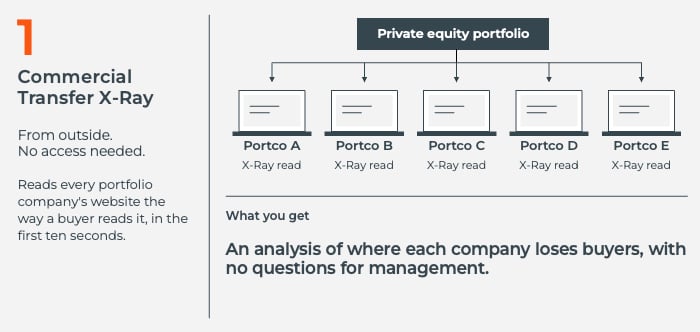
The X-Ray reads a portfolio company from the outside.
It assesses the commercial surface a buyer encounters and looks for whether the business makes the buyer's situation, value, relevance, proof and difference clear enough to continue.
No management interviews. No internal briefing.
That means we can run it across a portfolio before deciding where deeper investigation is warranted.
Start with breadth.
Portfolio → X-Ray → where buyers can see the value, and where it starts to disappear.
What it gives you
A consistent outside-in reading across portfolio companies.
Not a judgement on whether the underlying business is good.
A reading of whether a buyer can see what makes it valuable from the commercial surface in front of them.
02 Commercial Transfer Discovery
Can the business carry the value?
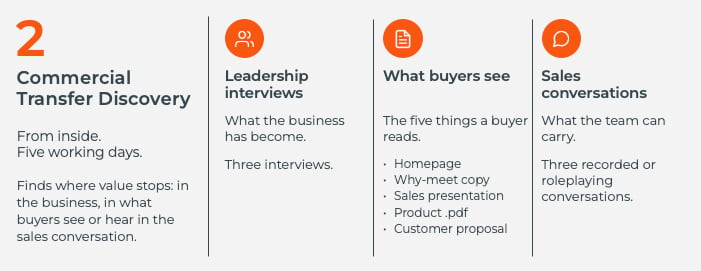
Where the X-Ray looks from outside, the Discovery goes inside.
In five working days we examine whether the account of customer value travels consistently through the business.
3 executive interviews
What does leadership believe customers value?
5 commercial surfaces
What does the market see?
3 recorded sales conversations or roleplays
What can the commercial team carry?
The result is a readout of where commercial transfer breaks, between leadership belief, market expression and sales conversation.
What it does not tell you
It does not establish why customers actually chose the company.
That requires customer evidence.
Where the Discovery shows that internal assumptions need testing, customer interviews become the next step — not an assumption built into the diagnosis.
Two readings. One picture.
Where does customer value stop transferring?
The X-Ray tells us what buyers can see.
The Discovery tells us what the business can carry.
Together, they produce four useful patterns:
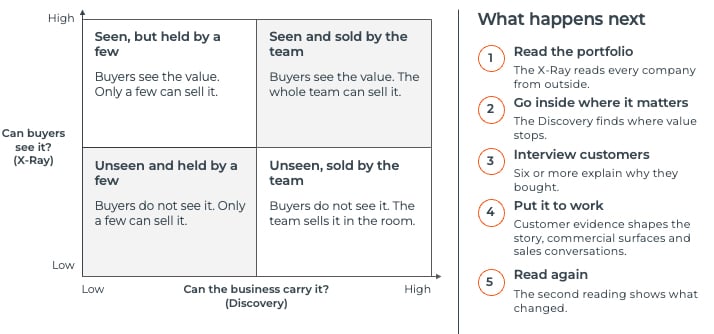
A company takes its place on the grid once both readings exist.
This isn't a league table. It tells us where to look next.
The question underneath all three
Can the business explain what customers value without you in the room?
We work with company CEOs and investors at these moments, usually the person carrying the explanation today, or the investor who will eventually have to underwrite it.
We turn what a few people can explain into something the wider organisation can carry.
Bring us one portfolio company
We don't need to start with the whole portfolio.
Give us one company where the numbers tell you something isn't travelling as it should, and we'll start from the outside.
