Two years challenging a B2B commercial system that protects the status quo, rewards activity over decisions, and measures seller effort instead of customer progress.
At times, it feels like banging my head against a brick wall.
Two customers loved the product. Both left.
A small software company had customers who loved its product.
The users were happy. Satisfaction scores were excellent.
Then a new executive arrived at its biggest European customer and was presented with an $800K renewal.
“Who the fuck are these people?”
The account went to a market leader. Another major customer followed.
Two of its biggest accounts, gone.
The people using the software understood its value. The executives deciding whether to keep paying did not.
User adoption is not executive conviction. A green health score is not a renewal strategy.
And renewal is another buying decision, often made by someone who wasn't there for the first one.
Now consider the bigger question.
If AI can increasingly handle routine customer interactions, what are we preparing our salespeople and Customer Success teams to do?
We've spent decades training people to behave like components in a process.
Now we're surprised that AI can automate the process.
Customers don't need another human behaving like a workflow.
They need someone who understands their circumstances, challenges assumptions, exercises judgement and helps them make consequential decisions.
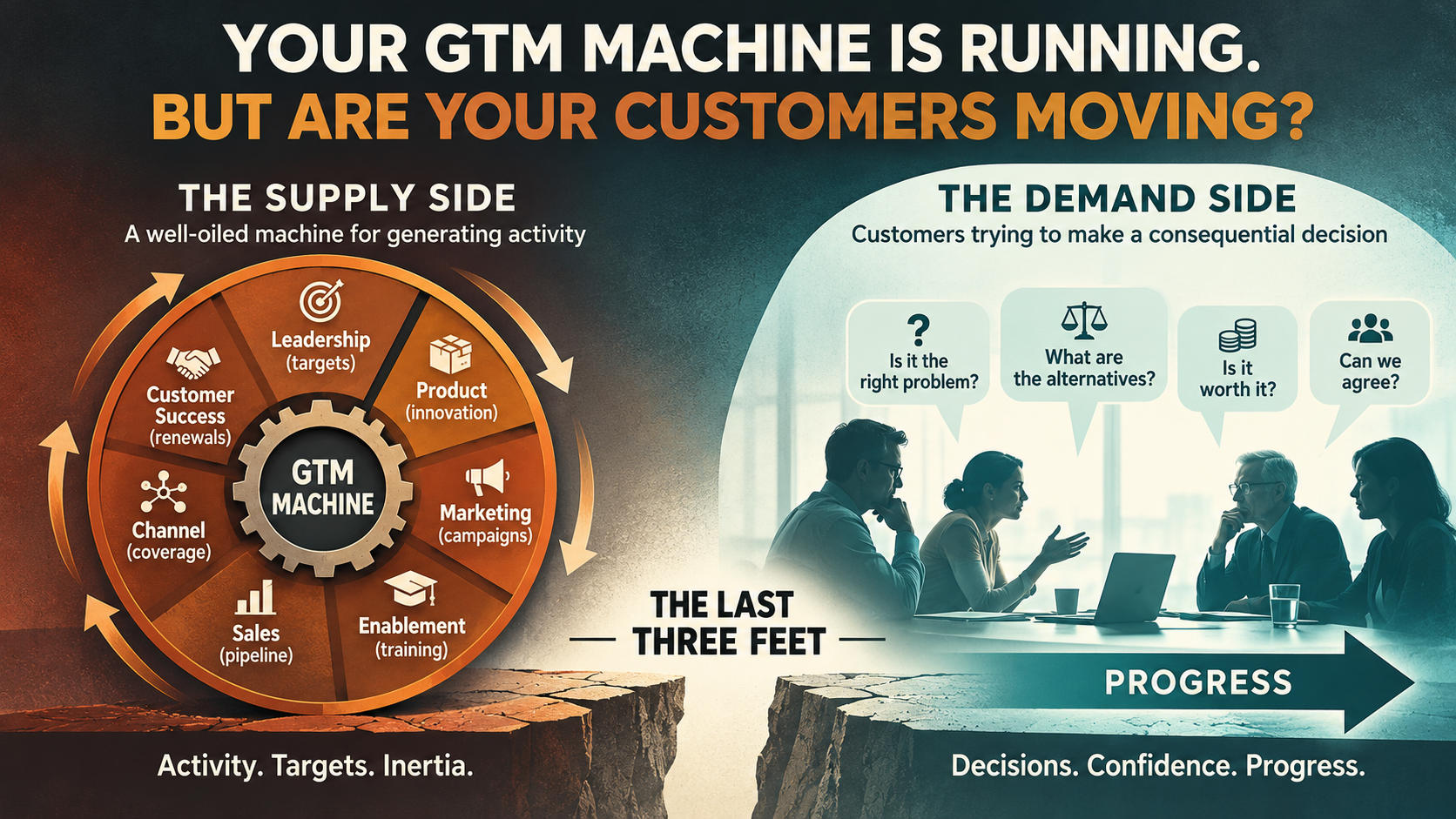
That's the last three feet.
And it's where the consequences of the entire commercial system become painfully visible.
Two years ago, my partners and I set out to build a consultancy around one belief.
If you want to grow, stop guessing why customers buy from you. Go and find out.
Find out what they were struggling with. What alternatives they considered. What gave them the confidence to act, what stopped them and why they stay.
Then use that evidence to change how you go to market.
After 22 years of consulting and decades in enterprise technology sales, it seemed obvious.
Two years later, I've never learnt more, been more motivated or been more disappointed.
We've had remarkable conversations with CEOs, CROs and sales leaders.
"Love it."
"Exactly what we need."
"We should do something together."
And then?
Nothing.
Another quarter. Another pipeline review. Another competing priority.
The idea disappears into the corporate never-never.
I've learnt to stop assuming this is simply a failure of leadership commitment.
The problem isn't necessarily the people. It's the system they're operating inside.
Nine deals lost. The answer? More pipeline.
Craig, my Shift90 co-founder, was interim CRO at a payroll software company winning roughly one deal in ten.
The sales manager's diagnosis was familiar.
“What we need is more pipeline.”
But consider the arithmetic.
Nine deals lost for every one won.
Why?
Were the opportunities genuinely winnable? Did customers understand the value? Were they ready to change? What alternatives did they consider?
Those were the questions worth answering first.
Building a stronger pipeline mattered. But it was a longer-term task, not a substitute for understanding why the existing opportunities weren't converting.
If we don't understand why customers aren't buying, why are we so confident that finding more of them will solve the problem?
And this isn't just a sales problem.
Leadership sets targets. Product innovates. Marketing builds propositions. Enablement trains sellers. Sales drives pipeline. Channels extend reach. Customer Success protects renewals.
Everyone works hard.
When results disappoint, the response is familiar.
More pipeline. More campaigns. More training. More partners. More customer touchpoints.
More COWBELL!
And now, more AI to automate it all.
We've built a commercial system around activity rather than customer progress.
Five questions worth asking on Monday morning
Leadership: If you're losing nine deals in ten, shouldn't understanding why come before demanding more pipeline?
Marketing: Are you helping customers recognise the problems they're struggling with, or asking them to navigate your increasingly complex portfolio?
Enablement: Are you preparing people to help a buying group reach a difficult decision, or simply to deliver a better product presentation?
Channel: After ten years working with partners, I developed a saying: “When you're truly ready, the channel will show up.” If your own people struggle to explain why a customer should change, why blame the partners?
Customer Success: Does the executive signing the renewal understand the business value your product creates, or does your CSM simply have an excellent relationship with its users?
These people aren't failing the system.
The system is failing to equip them for the decisions their customers need to make.
AI makes the last three feet matter more
I've been a HubSpot customer since 2008. Thanks, Pete Caputa!
For years, its excellent support team helped me solve tricky problems.
Today, its AI support bot resolves everything I ask.
I haven't spoken to a person for the past year.
And that's progress.
AI can already do much of the routine work we've organised commercial teams around.
But consider the buying group that cannot agree.
The new executive questioning a major investment.
The customer whose priorities have changed.
Those moments require more than another presentation or completed workflow.
They require someone who can understand what's at stake, help people work through competing interests and take responsibility for commitments made.
The salesperson or CSM standing in front of that customer inherits decisions made by leadership, product, marketing, enablement and channel management.
When the conversation fails, we tend to blame the person.
But what did the system equip them to do?
The last three feet aren't just where individual performance is tested.
They're where the consequences of the entire commercial system become painfully visible.
The hardest lesson has been about ourselves
There's an irony I can't ignore.
We've spent two years trying to help companies understand why their customers struggle to make buying decisions.
And we've experienced that same inertia ourselves.
A private equity partner once explained his approach to me in six words.
“We only act when it's necessary.”
He found our ideas interesting.
But interesting wasn't necessary.
And that was our problem to understand.
We'd spent too much time showing him our approach and too little time exploring what was happening inside his business.
We've mistaken enthusiasm for commitment.
We've watched opportunities disappear.
And we've had to challenge our own assumptions about what makes change worth pursuing.
We're learning to start somewhere different.
Less time explaining our methodology. More time understanding a prospective client's circumstances, why they matter now and what would have to change for someone to act.
Because if we can't establish that, we haven't earned the right to talk about a project.
Recognising the need for change isn't the same as being ready to act.
Changing the system requires budget, agreement, risk and accountability.
Doing nothing requires very little.
Nobody receives an invoice for preserving the status quo.
For leaders prepared to act
I'm not looking for another conversation about how interesting this all sounds.
I'm interested in leaders who've spent enough time in the trenches to recognise the problem