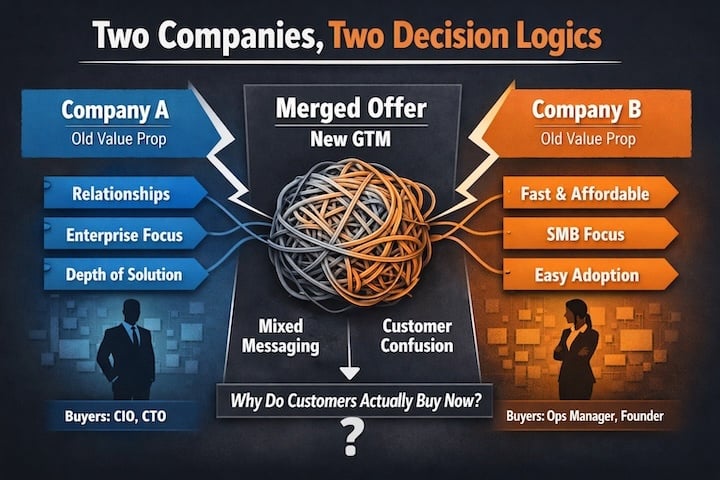
Two Companies, Two Decision Logics:
Six months post-acquisition. Your Year 1 plan depends on commercial synergies. Your customers are confused. Your sales team is winging it.
You acquired Company B to accelerate growth. The thesis was sound: combine enterprise relationships with SMB velocity, cross-sell the portfolios, hit £18M ARR by month 12.
Month 6: You're at £9M. Pipeline's messy. Churn's up 12%.
Your integration team built a "unified GTM strategy" in a conference room. New value prop. New pitch deck. New positioning.
Your sales team is standing in front of customers trying to explain it.
The problem:
Company A's best customers bought because they couldn't explain to their board why IT projects ran over budget. You solved the accountability gap.
Company B's best customers bought because enterprise vendors took six months to implement. You solved the speed problem.
These are fundamentally different struggling moments. Different triggers. Different buyers. Different decision criteria.
The Merge-First Trap
Your integration playbook said: "Unify messaging by Q2."
So you built a value prop that tries to be both:
- "Enterprise-grade depth with startup speed"
- "Fast deployment meets robust integration"
- "Easy adoption, powerful capabilities"
Your Company A reps are pitching "fast and affordable" to CIOs who don't care about speed. They care about traceability.
Your Company B reps are pitching "deep enterprise integration" to founders who just want to go live by Friday.
Customers hear noise. Conversion drops.
The thesis was right. The execution sequence was wrong.
Money Doesn't Fix GTM Logic. It Multiplies It.
You raised capital or completed M&A to scale GTM.
But if you don't know why customers bought from each company pre-merger, you're scaling confusion.
Weak decision logic + capital = amplified inconsistency
Clear decision logic + capital = amplified scale
The question your Year 1 plan needs to answer:
"Why do customers actually buy now, from the merged entity, and which struggling moments do we preserve vs retire?"
What To Do Before You Unify
1. Extract both decision patterns
Interview 5-8 customers from each company who bought in the 12 months pre-acquisition. Ask them to walk through their switch timeline:
- When did you first realise you had a problem?
- What did you try before us?
- What almost stopped you from buying?
- Why did you choose us over alternatives?
You're looking for struggling moments, not satisfaction scores.
2. Map the overlap vs divergence
Plot both sets of interviews on a struggling moments table:
- Which doors do both companies share?
- Which struggling moments are unique to each?
- Which buyer types can actually be merged?
Example: Company A's "mid-market CIO" and Company B's "tech-forward founder" might both struggle with audit traceability. That's a mergeable segment.
But Company A's "Fortune 500 CIO" and Company B's "two-person startup" have zero overlap. Don't force it.
3. Build per-door GTM, not one-size-fits-all
Your unified GTM isn't one pitch deck. It's a door-based architecture where reps know which struggling moment they're addressing and which story to tell.
Preserve Company A doors that still drive revenue. Preserve Company B doors. Create new doors where patterns genuinely overlap.
4. Train reps to match doors, not recite decks
Role-play discovery:
Rep hears: "I can't explain to the board why our last three projects ran over budget."
Rep recognises: Company A door (accountability gap)
Rep delivers: Company A proof story + positioning
Different customer: "Our last vendor took nine months to go live."
Rep recognises: Company B door (speed problem)
Rep delivers: Company B proof story
Same company. Different doors. Different conversations.
The Year 1 Question
Most post-M&A commercial integrations fail because they prioritize organizational unity over customer truth.
You want one sales team, one pitch, one forecast model. That's fine eventually.
But if you unify before you extract why customers bought from each entity, you destroy the patterns that made each acquisition valuable.
Your Year 1 board review isn't about synergy slides. It's about revenue delivery.
The only way to hit your number: preserve what worked, retire what didn't, and scale the patterns worth scaling.
Not the org chart. The decision logic.
The Takeaway
If you're post-raise or post-M&A and staring at a Year 1 gap:
Stop building new messaging in conference rooms.
Interview your best customers from the last 12 months. Ask them why they bought. Extract the struggling moments.
Build your GTM around those, not around what sounds good in an all-hands.
Money doesn't fix weak GTM logic. It multiplies it.
Shift90 | Customer Truth → Faster Decisions → Repeatable GTM
If you're six months post-acquisition with a Year 1 revenue gap, we can help. We extract decision patterns from your best customers (both entities), identify which struggling moments to preserve, and build a door-based GTM architecture that doesn't destroy what made each company work. Let's talk.