Should UK Business Schools Teach Jobs to Be Done in Their Sales Programmes
UK business schools need to integrate Jobs-to-be-Done thinking into sales programs to shift from vendor-centric to buyer-centric education, enhancing real-world sales effectiveness.
Recently, I attended the UK's flagship sales conference. Not once did anyone mention the customer. It felt like a trip back in time.
Why the "State of Sales" feels like it's stuck in 2010
I recently attended a conference in the UK, the "State of Sales 2025." Warwick Business School and the Institute of Sales Professionals sponsored it. Serious credentials. Serious venue and an interested and engaged cohort.
And yet, walking out, I couldn't shake the feeling that I'd stepped through a time warp. Back to 2010. Back to a world where selling was something you didtocustomers, notwiththem.
The entire day was supply-side. Compensation models. Incentive schemes. Sales Process pros and cons. AI adoption rates. Professional development pathways. Sales performance metrics. How to structure a sales organisation. How to motivate reps. How to measure activity.
Not once did anyone mention the customer.
No discussion of why buyers change. No exploration of struggling moments. No research into what progress customers are actually trying to make. No acknowledgement that the buyer's context shapes everything.
It was pure vendor logic. Product push. Features and benefits. Sales process optimisation. The old paradigm, delivered with academic seriousness and PowerPoint precision.
The Supply-Side Trap
I’ve been on the Demand-side of the paradigm for three years and clearly see the problem with Supply-side thinking in sales education.
It assumes the hard part is execution. Train the rep. Optimise the process. Align the incentives. Hit the number.
But execution isn't where most deals die. Deals die because sellers don't understand why buyers move. They don't know what triggered the search. They can't articulate the struggling moment… the source of all opportunity. They pitch features when the buyer needs progress.
The Warwick Business School Sales Excellence Hub, launched in 2024, describes its mission as connecting "sales professionals with leading sales researchers to achieve sales thought leadership." Their State of Sales Study tracks themes like professional development pathways, incentive models, and AI adoption.
All supply-side. All internal. All about what the seller does, not what the buyer needs.
This isn't a criticism of the individuals involved. Professor Nick Lee and Dr Roland Kassemeier are respected researchers. The Institute of Sales Professionals does important work in professionalising the discipline.
But when your flagship research programme doesn't include a single demand-side metric, you have to ask the question. Why not?
What Bobby Moesta Gets Right
Bobby Moesta, co-architect of the Jobs-to-be-Done (JTBD) framework with the late Clayton Christensen, recently wrote about what business schools get wrong.
His argument is sharp: business schools teach youwhatthings are andhowthey work, but they're terrible at teaching youwho,when,where, andwhy.
They give you a toolbox without teaching you when to use the tools.
Moesta's point isn't that MBA programmes need to throw out their curriculum. It's that every discipline needs a demand-side lens. Accounting. Strategy. Marketing. And yes, sales.
Without that lens, students graduate with frameworks they can't apply. They know the theory of a sales methodology, but they don't know when it works and when it fails. They can recite the stages of a pipeline, but they can't read a buyer's hesitation.
JTBD thinking fills this gap. It starts with the customer's context. What progress are they trying to make? What's standing in their way? What triggered their search? What would success look like for them?
When you understand the job, you understand when to use which tool. You know when to push and when to pause. You recognise that the same product solves different jobs for different buyers.
This is strategic clarity.
The UK Sales Education Landscape
Let's look at what's actually being taught.
Warwick Business Schoolmade headlines in May 2025 and is to be congratulated for becoming the first UK business school to add a dedicated sales module to its MBA programme. The Institute of Sales Professionals called it "a landmark move for business education."
That's welcome progress. But let's be clear about what's being taught. The collaboration focuses on "strategic sales management, negotiation and digital transformation." Real-world learning experiences. Mentoring from sales leaders.
Still supply-side. Still, about making sellers better at selling. Still no structural integration of buyer insight.
Middlesex Universityoffers the UK's only undergraduate degree in B2B Sales, delivered as an apprenticeship programme. The curriculum covers sales strategy, digital and social environments, and work-based projects. It's practical and employer-focused.
But again, the framing is vendor-centric. How do we develop salespeople? How do we structure territories? How do we measure performance?
BournemouthandPortsmouthoffer marketing degrees with sales components, accredited by the Chartered Institute of Marketing. These programmes touch on consumer behaviour and brand management, but sales remains a secondary concern, tucked inside broader marketing frameworks.
Nowhere in the UK is there a sales programme that starts with the customer. Nowhere is JTBD thinking embedded in the curriculum. Nowhere are students taught to conduct switch interviews, map struggling moments, or build demand-side positioning.
Buyer Facilitation, Not Sales Process
Here's what wasn't mentioned once at the conference: buyer facilitation.
The entire day was structured around selling and the sales process. How do we implement E-commerce? How do we retain salespeople? There was even a paper on sales and marketing alignment.
This is supply-side logic at its most seductive. It feels rigorous. It's measurable. It fills dashboards with colourful charts.
But it's old paradigm thinking.
Buyers don't move through your process. They move through their own transitions. And those transitions involve multiple stakeholders with different concerns, different timelines, and different definitions of progress.
The CFO needs ROI justification. Legal needs risk mitigation. IT needs integration assurance. Compliance needs regulatory alignment. Procurement needs vendor validation.
Each of these constituents is on their own journey. Each has their own struggling moments. Each needs to make progress before the deal can close.
A sales process ignores this complexity. It treats the deal as a single thread moving through seller-defined stages. Qualify. Demo. Proposal. Negotiate. Close.
Buyer facilitation starts from the other side. It asks: what transitions does each stakeholder need to make? What information do they need? What concerns must be addressed? What does progress look like for them?
This is where Mutual Action Plans (MAP) come in. Not as a sales tool to "lock in next steps" and control the deal. But as a genuine alignment mechanism that maps the work each party needs to do.
A proper MAP doesn't just list your activities. It lists theirs. It acknowledges that Legal needs three weeks for contract review. IT needs a security assessment. Finance needs budget approval from the board. Compliance needs to verify compliance with data-handling policies.
When you build a MAP with each constituent, you're facilitating a buying process, and the impact is shorter cycle times, improved win rates and greater average deal size. You're helping multiple stakeholders coordinate their progress toward a shared outcome.
This is consultative selling in its truest form. Not "consultative" as in "I ask questions before I pitch." Consultative as in "I help you navigate the complexity of your own internal buying process and organisational inertia to achieve a high-quality outcome."
Not a word of this at the State of Sales conference. Not a single mention of how buying actually works in complex B2B environments.
What Would Change If JTBD Was Taught?
Moesta poses a useful thought experiment: if Jobs to be Done thinking was widely understood, how would it change business school curriculum?
His answer is nuanced. JTBD shouldn't be the centre of any curriculum. But it should be a supplement that helps students understand what progress they're trying to make, and empathise with the progress other people are trying to make.
Applied to sales education, this would mean:
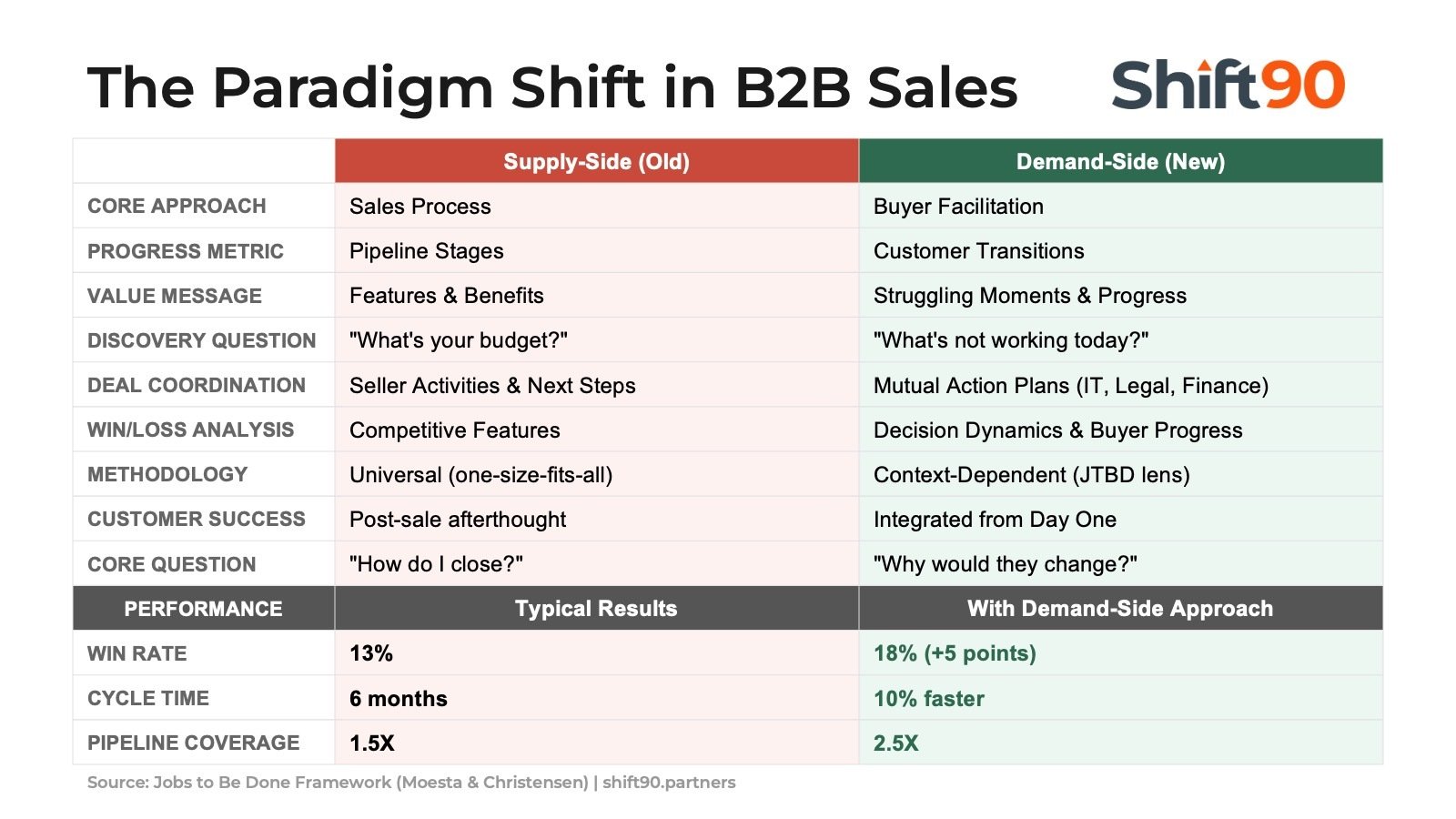
Sales process would be replaced by buyer facilitation.Instead of teaching students to move prospects through pipeline stages, programmes would teach them to align with the transitions in a customer's buying process. Students would learn to map the customer buying process, stakeholder journeys, identify what progress each constituent needs to make. They have hands-on experience and build Mutual Action Plans that coordinate the work across IT, Legal, Finance, Compliance, and Procurement. They learn to use buyer facilitation platforms, more commonly known as Digital Sales Rooms, likeAligned, Trumpet or Qwilr, to engage stakeholders, share content, build consensus, manage a sequence of MAPs and empower champions to make the case for change when you're not there.
Discovery would start with the buyer's context, not the seller's qualification criteria.Instead of teaching reps to ask "What's your budget?" and "Who's the decision maker?", programmes would teach them to ask "What's not working today?" and "What would success look like for you?"
Positioning would be built from customer language, not internal messaging workshops.Students would learn to conduct customer Switch Interviews, extract struggling moments, and build narratives that reflect how buyers actually describe their problems.
Win/loss analysis would focus on decision dynamics, not competitive features.Instead of asking "Why did we lose to Competitor X?", students would learn to ask "What progress was the buyer trying to make, and why did they believe someone else could deliver it faster?"
Sales methodology would be taught as context-dependent rather than universal.SPIN works brilliantly in some situations and fails in others. Challenger Selling lands when buyers need to be disrupted, and backfires when they need to be reassured. JTBD thinking teaches students to read context and choose accordingly.
Customer success would be integrated from day one.Expansion and renewal aren't afterthoughts. They're the proof that you understood the job. Programmes would teach the connection between initial sale and long-term value delivery.
Sales and Marketing are aligned from day one and work as a unit.Same vocabulary, shared objectives, focus on the company's North Star Metric, not vanity metrics or lead attribution, but unit economics.
A Modest Proposal for Warwick and the ISP
The State of Sales Study is positioned as "the UK's annual barometer of the sales profession." It has the potential to shape how British companies think about sales excellence, and I’m genuinely excited about the possibility.
Here's my suggestion: add a demand-side track.
Don't just survey salespeople and sales leaders; interview and survey buyers. What made them engage? What nearly blocked the deal? What would have accelerated their decision? What language do they use to describe the problem your sellers solved? How many stakeholders were involved, and how did each of them need to make progress?
Complement the research on compensation models and AI adoption with research on buyer behaviour. Track how decision-making is changing. Measure the gap between how sellers pitch and how buyers describe value. Study how buying committees actually function, and what makes deals stall.
And in the curriculum, make room for demand-side thinking. Teach buyer facilitation instead of sales process. Teach students to build Mutual Action Plans that map stakeholder transitions, not seller activities. Teach them to have different conversations with IT, Legal, Finance, and Procurement, because each constituent has different concerns and different definitions of progress.
Make JTBD a foundational lens. Teach students to start with the customer. Teach them to surface struggling moments before they build pitch decks. Teach them that the most important question in sales isn't "How do I close?" but "Why would they change, and what does each stakeholder need, to say yes?"
The Real State of Sales
The real state of sales in 2025 isn't about incentive schemes or AI adoption rates.
It's a paradigm shift in how buying happens that most sales organisations haven't caught up with. I asked Matt Lerner, (author of #GrowthLevers and a JTBD teacher in his immersive coaching programs) how deeply he thought JTBD was penetrated in B2B. Answer about 5%.
Demand-side thinking is a true paradigm shift, and early JTBD adopters are making clear headway in a market filled with noise.
Buying journeys are non-linear. Decision-making is distributed across multiple stakeholders. Consensus is harder to build. Each constituent in a deal has their own timeline, their own concerns, their own definition of progress.
In this world, a sales process is a liability. It creates friction. It treats complex, multi-stakeholder decisions as linear progressions through seller-defined stages. It optimises for the wrong thing.
The companies winning today don't run sales processes. They facilitate buying. They understand that their job isn't to move deals through a pipeline. It's to help multiple stakeholders coordinate their progress toward a shared outcome.
They build Mutual Action Plans that acknowledge the buyer's complexity. They align their activities to the customer's transitions, not their own stages. They equip sellers to have different conversations with different constituents, because IT's struggling moment isn't the same as Finance's, and Legal's concerns aren't the same as Compliance's.
This isn't theory. It's the difference between motion and momentum. Between activity and revenue. Between hitting quota and building a business.
The Question for UK Business Schools
If you're running a sales programme, ask yourself: what percentage of your curriculum starts with the customer?
If the answer is close to zero, you're preparing students for a world that no longer exists.
The tools matter. The methodologies matter. The compensation models matter.
But none of it matters if you don't understand why buyers move.
That's the job. That's the work. It's 2025. The opportunity is there for whoever takes it first!
Learn how the Sales Prologue technique shifts sales meetings from seller-driven pitches to buyer-led discussions, fostering trust and engagement for...
Explore the critical gap in B2B channel sales where partner conversations often miss the buyer's evolving needs, impacting decision-making and...
Mark Gibson
Mar 25, 2026
Stay Ahead with the Latest B2B Marketing Insights
Be the first to access fresh, expert-driven insights to strengthen your marketing function. Our updates provide practical strategies and industry best practices to help you stay competitive and make informed decisions.
Your privacy is important to us. Your contact details will remain confidential, and you’ll only receive insights that add real value to your business.